With more than two decades of experience driving product innovation in the security systems industry, one thing has always stood out to me: the intelligence buried within the massive volume of logs these systems produce every single day.
Physical Access Control Systems, often known as PACS, and Visitor Management Systems, often known as VMS, are generally viewed as security applications. But in reality, they are among the most active digital touchpoints within any building.
They engage with nearly every type of person who enters, works in, operates, leases, maintains, or visits a facility. They determine who can enter, where access is allowed, when that access is valid, and under what conditions. This makes them the first layer of protection for a facility and, at the same time, one of the most important experience layers in modern commercial real estate.
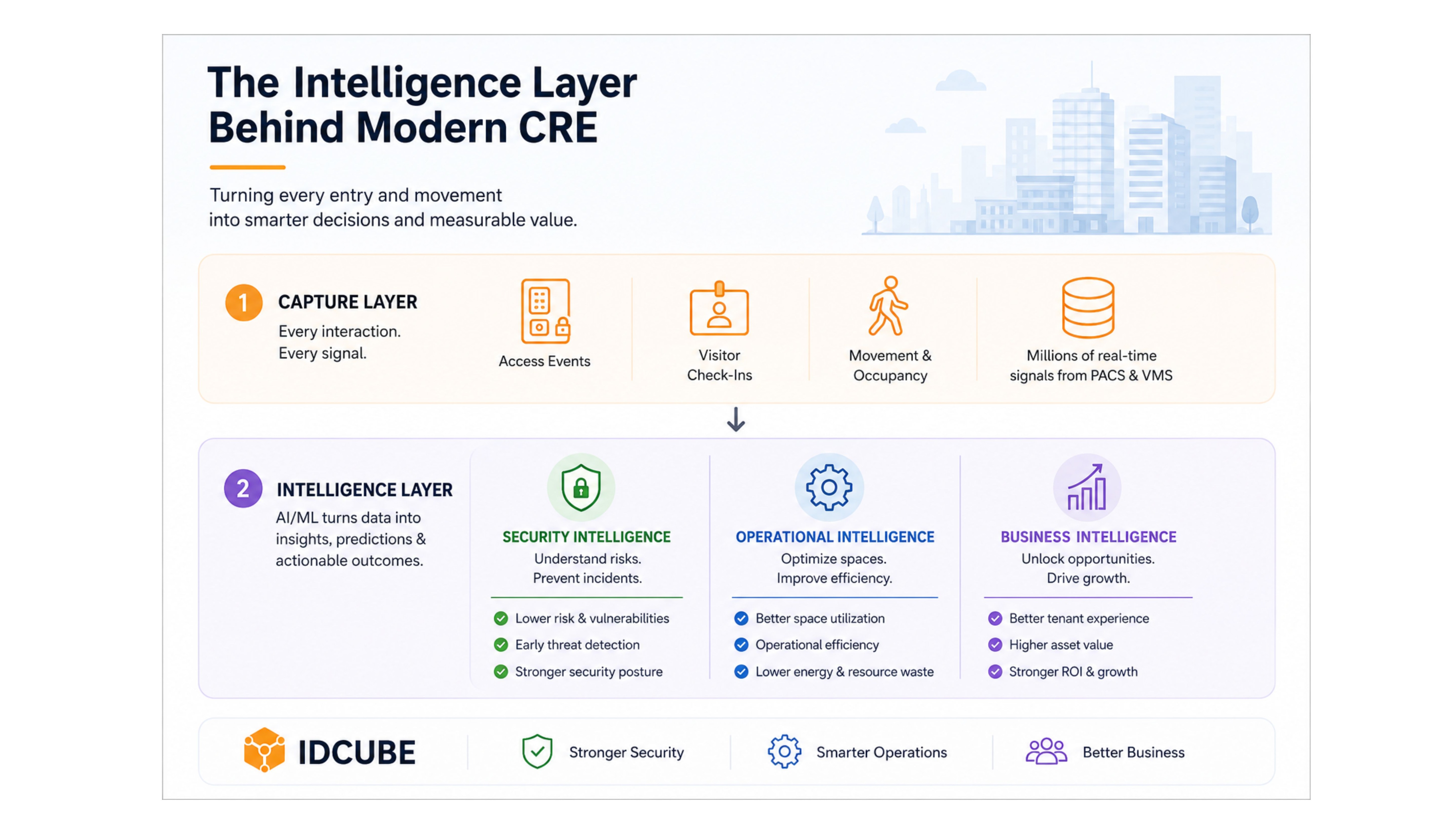
Every access event, denied entry, visitor check-in, movement pattern, and occupancy trend generates a signal. For many years, I have believed that these signals hold much more value than basic audit records. They show how a building is being used, where risks are present, where inefficiencies remain unnoticed, and where new business opportunities may be taking shape.
This belief gradually became a focused area of work at IDCUBE. Around five years ago, we set up a data science team to study patterns emerging across hundreds of facilities using our systems across different countries and operating environments.
The objective was simple: convert PACS and VMS data into predictive insights, practical recommendations, and measurable business value for organizations, particularly in commercial real estate.
As we studied this opportunity more deeply, we started seeing the intelligence potential of these systems across three separate but closely connected areas.
Here’s the reworded version, keeping the same tone, flow, analogy, and information intact:
Security Intelligence
Security intelligence is not simply about managing alarms or reacting to incidents once they have already happened. That is the conventional way of looking at security operations. Real security intelligence is about benchmarking a facility, uncovering hidden vulnerabilities, understanding the reasons behind those vulnerabilities, and suggesting clear, actionable steps to reduce risk.
A simple analogy explains this well.
When you ask your child how much they scored in a mathematics test, and the answer is 85 out of 100, your reaction may not be instant. Is 85 a good score? The answer depends on context. How much did the child score in earlier tests? How did the other students perform in the same exam? If it was a national-level test, what was the child’s percentile ranking?
Only after comparing the score with past performance, peer performance, and wider benchmarks can you truly understand whether the result is excellent, average, or a matter of concern.
But comparison alone is still not enough. If the child lost 15 marks, you would want to know the reason. Were the marks lost in trigonometry, algebraic equations, calculus, or due to careless mistakes? This root cause analysis is what helps you decide the right next step. Without it, the score remains just a number. With it, the score becomes a roadmap for improvement.
The same idea applies to security intelligence in commercial real estate.
A facility may generate thousands, or even millions, of access events, alarms, visitor logs, denied access attempts, and movement records. By themselves, these logs do not reveal the complete picture. Their real value appears when these signals are analyzed against risky patterns, best practices, historical trends, global data points, and peer benchmarks.
At IDCUBE, we have been studying more than 50 risk patterns to help organizations understand where their facilities may be vulnerable. The purpose is not only to show what has happened, but to turn security events into risk intelligence: what is going wrong, why it is happening, and which actions can reduce exposure.
This creates an overall risk dashboard for a facility, covering identified vulnerabilities, a facility risk score, root cause analysis, insider threat indicators, and comparison matrices across multiple facilities. For large CRE portfolios, this becomes highly valuable because security leaders can compare one building with another, identify weaker locations, prioritize interventions, and monitor improvement over time.
This journey is still progressing. Security risk intelligence will keep becoming stronger as systems learn from more facilities, more patterns, and more real-world operating conditions. The direction is evident: security systems are moving beyond event reporting and becoming intelligence engines that help organizations continuously benchmark risk, understand vulnerabilities, and strengthen their facilities.
Operational Intelligence
Operational intelligence is becoming one of the most critical dimensions of modern CRE because every organization today wants smarter facilities. But the word “smart” should not be mistaken for aesthetics, automation, or technology added for its own sake. A building becomes truly smart only when it creates measurable efficiency.
If intelligence does not reduce waste, save time, improve resource utilization, lower energy consumption, or make operations more responsive, then it is not truly intelligence. It is simply another layer of technology.
This is where people movement data becomes highly valuable. At IDCUBE, we have worked deeply on monitoring, recording, and analyzing movement patterns, occupancy, footfall, and headcount across facilities and zones over different time periods. This helps organizations understand how spaces are actually being used, rather than how they were assumed to be used during planning.
The result is a much more dynamic view of facility operations. CRE and facility teams can identify peak occupancy hours, underused zones, high-traffic areas, unusual crowding, floor-wise usage patterns, visitor density, employee movement, and zone-level activity trends. These insights directly help improve planning for HVAC, lighting, housekeeping, cafeteria operations, security deployment, meeting room usage, and shared resources.
For example, if a specific floor shows low occupancy through most of the week, energy usage and facility services can be optimized accordingly. If a cafeteria experiences predictable peaks based on employee movement, staffing and supply planning become better. If certain entry points show repeated congestion, access policies, turnstile allocation, or visitor processing flows can be redesigned.
Operational intelligence transforms buildings from fixed assets into responsive environments. Instead of running facilities on assumptions, fixed schedules, or manual observations, organizations can operate them based on real usage patterns. This is the foundation of efficiency-led smart buildings.
Business Intelligence
If we view CRE from a business lens, the question is straightforward: how does an organization build and grow a business that is stable, profitable, and resilient?
The first priority is protecting the asset, reducing exposure, and maintaining business continuity. This comes from security intelligence, which turns security events into measurable risk intelligence. The second priority is improving operational efficiency and profitability. This comes from operational intelligence. The third priority is growth: how to retain tenants, improve asset value, strengthen rental strategy, and identify future opportunities. This is where business intelligence becomes essential.
Business intelligence transforms facility usage data into strategic inputs for decision-making. It helps CRE owners, operators, and facility managers understand how different tenants, departments, employees, vendors, and visitors are actually using the property. Instead of depending only on lease documents, assumptions, or periodic feedback, they get measurable evidence of real utilization.
For example, when movement and visitor data are mapped to tenants, it reveals which tenants are actively using the facility, which tenants are underutilizing their leased space, and which tenants are placing unusually high load on shared infrastructure. This intelligence becomes highly valuable during rental renewals, tenant engagement, and future leasing decisions. Declining movement, reduced visitor activity, or lower space usage may indicate that a tenant is at risk of downsizing or exiting. Increasing utilization, higher visitor traffic, and expanding movement patterns may indicate that a tenant is ready for expansion, premium services, or a larger commitment. CRE leaders no longer need to wait for renewal conversations to understand tenant intent; the facility itself starts revealing early business signals.
For CRE businesses, this is where operational data becomes revenue intelligence. PACS and VMS offer a strategic view of asset performance, tenant health, space demand, and future growth potential. They help owners and operators shift from reactive facility management to proactive portfolio growth, where every movement pattern supports better retention, smarter leasing, stronger forecasting, and improved commercial outcomes.
This shift is already happening. Modern CRE is moving from buildings that are simply connected to buildings that are truly intelligent, facilities that understand human flow, interpret operational signals, and convert everyday movement into better decisions.
Physical Access Control Systems and Visitor Management Systems are no longer only tools for allowing or denying entry. They are becoming the intelligence layer behind modern commercial real estate.