


Dr. Arindam Bhadra
Director

As you are no doubt aware, in July 2025 BSI released BS EN 14972-17:2025 - Fixed firefighting systems. Water mist systems - Test protocol for residential occupancies for automatic nozzle systems as a replacement for the BS 8458 standard which has been withdrawn as of 7 July 2025. We thought it would be useful to provide an update on this based on what we know currently.
What is the British standard for mist system?
If you’re looking for a fixed fire suppression system, you’ve probably come across British Standard: 8458 (BS:8458) a few times already, and if you’re unfamiliar with the British Standards for Fire Protection, we’ll help you understand it a bit more.
Unlike sprinkler systems, the BS:8458 is the standard of compliance for fixed fire protection systems (both domestic and residential fire suppression systems, that fall exclusively under the water mist category. This could either be a low-pressure water mist system or a high-pressure water mist system.
BS 8458 ‘primarily covers water mist systems used for life safety but might also provide property protection’. It contains recommendations for water mist systems installed in domestic and residential occupancies concerning their design, installation, water supplies, commissioning, maintenance and fire performance testing of installed systems. In BS 8458, the system is categorised as either ‘domestic occupancy’ or ‘residential occupancy‘.
‘Domestic’ includes individual dwelling houses, individual flats, individual maisonettes, transportable homes, house of multiple occupation, bed and breakfast accommodation, boarding houses and blocks of flats 18m or less in height with a maximum total floor area of 2,400 m2 .
‘Residential’ includes blocks of flats greater than 18 m in height, sheltered and extra care housing, residential care premises, residential rehabilitation accommodation, dormitories and hostels. This standard primarily covers buildings up to 45 m in height. BS 8458 can be applied to maximum room sizes of 8 m by 4 m (or 32 m2 ), 10 m by 5 m (or 50 m2 ) or 80 m2 (depending on nozzle spacing and relevant successful fire performance test results) and a maximum room height of 3.5 m or 5.5 m (depending on relevant successful fire performance test results).
Because of the bespoke nature of water mist systems, this British Standard contains ’generic rules’ rather than ‘prescriptive design rules’. Therefore, successful results in all of the BS 8458 specified fire performance tests are critical and necessary to determine the systems design and components characteristics.
Here are a few important things to look out for to ensure you choose a misting system that complies with British Standards (BS:8458) for fire protection.
1. Ceiling mounted nozzles
BS:8458 compliant systems utilise ceiling-mounted nozzles. Attacking a fire from the side (wall-mounted nozzles) can encourage fire growth, and the pressure of the water mist can cause the fire to move sideways, although only temporarily, it could be enough to ignite a flammable object nearby and cause the fire to develop further.
On the opposition, attacking the fire from above using a ceiling-mounted nozzle leads to a quicker and more successful suppression. The mist from the water mist system will push the head to the ground until it’s neutralised, whilst simultaneously acting as a fire blanket and suffocating the flame.
Aside from the technical practicalities of having a ceiling-mounted nozzle, they also give you free reign to place your furnishings wherever you please. Something simple, such as a plant, can have a great impact on the direction of the mist on activation.
2. A ‘wet pipe system’
Another factor you should consider when choosing a fixed fire suppression system that complies with British Standards is a ‘wet pipe system’.
Whilst you might not be able to see this first hand, the wet pipe system is key for fire suppression. The water remains loaded in the pipes, ready for activation. With the water being prepared in the pipe in case of activation, this ensures a rapid response time. When a fire activates, time is paramount, and every millisecond matters.
3. Mechanical activation
In terms of ‘mechanical activation,’ this simply means, that for the system to be activated, there needs to be a physical change. The Mist system, which is BS: 8458 compliant, uses a small frangible bulb that bursts when it reaches 68 degrees. Electronically activated systems run off a circuit, which could fail to activate if there’s a disruption.
Mechanically activated misting systems ensure the system is effective in the event of a fire, and activate when necessary, and not alongside a fire detector, which we all know can activate from some burnt toast. This system also means that it needs to be serviced less regularly, such as the Mist system only needing a yearly service.
System Design Mist Fire Suppression systems:
BS 8458 Watermist Systems Testing
At the Fire Protection Association, we offer testing on residential and domestic watermist systems to BS 8458 : 2015. Watermist systems are highly effective but must be designed with the exact environment in mind. As the design of each system is often almost entirely unique, each system should be tested prior to installation.
We are passionate about improving fire safety standards across the built environment and we are proud to be leading the way as one of the first UKAS accredited fire testing facilities in the UK to offer this important British Standard test.
This test provides residential and domestic system designers and installers the assurance their system has been tested to the highest standard and will perform as intended should a fire occur when installed under the test conditions.
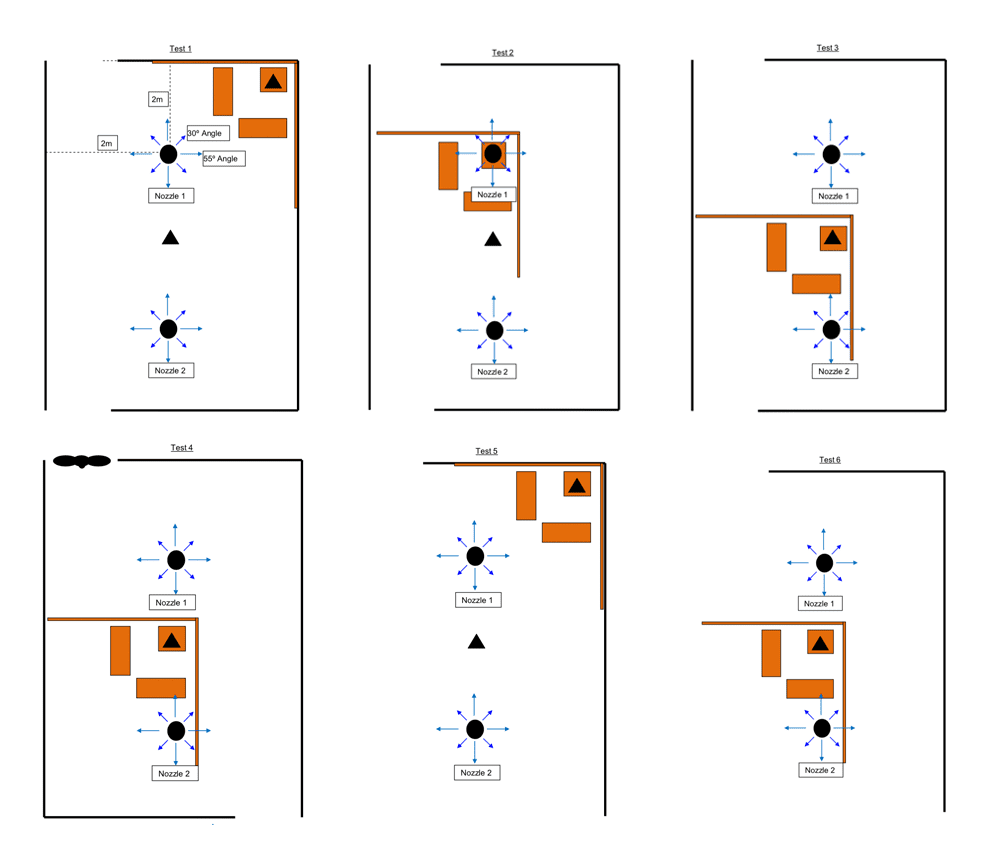
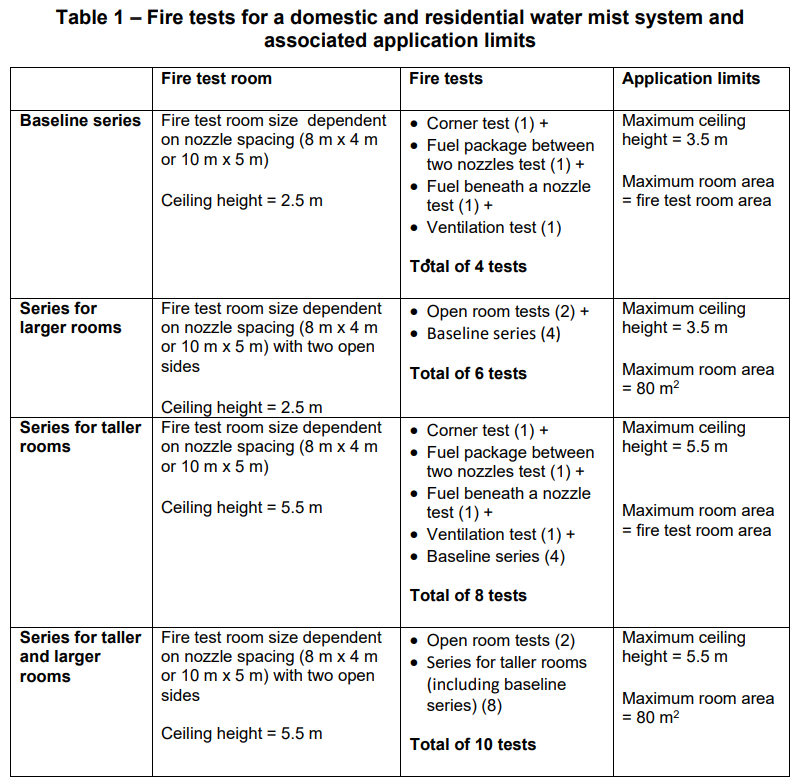
BS 8458 includes a baseline series of stylised simulated room fire tests against which the performance of water mist systems can be assessed. The size of the test room depends on the nozzle spacing (32 m2 up to 50 m2 ) and the ceiling height is 2.5 m. The tests cover different fire load positions and ventilation conditions. BS 8458 includes an option for an additional series of fire tests for taller rooms with a maximum ceiling height of 5.5 m. BS 8458 includes an option for two additional open sided fire tests for larger rooms up to 80 m2 . Additives, if used, are taken into account in the tests. The test fires last 10 minutes for domestic premises and 30 minutes for residential premises, measured from the operation of the first nozzle. To pass each test the system shall suppress the fire for the duration of the test. The acceptance criteria involve recorded temperatures at specific locations not exceeding specified values, and non-operation of a nozzle external to the test room, in accordance with all clauses BS 8458 (e.g. 6.1 and Annex C). The series of BS 8458: 2015 fire tests is summarised in Table 1 with their associated application limits.
We work with residential watermist system designers and installers to provide a testing regime which works for them. Our independent testing facility provides an ideal environment in which to research and develop residential systems.
Checklist questions for the designer, installer and commissioner of the system to provide to Building Control Bodies confirming compliance with the installation standard:
Declarations of Conformity (MDOC and CDOC) for the manufacturer, designer, installer and commissioner of the system should be provided to Building Control Bodies to enable them to come to a judgement on the suitability of a water mist system use for specific residential building applications and to confirm or otherwise compliance with BS 8458.
Checklist questions are included below, for consideration by Building Control Bodies when reviewing the project and Declarations of Conformity.
Introductory information
Scheme details (name and address of building)
Project description
Is this a BS 8458 automatic water mist system?
· Is the main purpose of this system to meet the regulatory life safety requirement for automatic fire suppression in new or converted residential premises in Wales, as an alternative to a residential sprinkler system?
Is this proposed water mist system being installed in residential building types covered in Approved Document B (Wales) section 2?
Is the proposed water mist system being installed in a home for children under the age of 18 covered by the Domestic Fire Safety (Wales) Measure 2011?
Are all areas protected apart from permitted exceptions?(see BS 8458 clause 6.4)
Are there any special hazards or any special circumstances?
Is the designer, installer suitably trained and qualified?
Are all areas of the building within the application limits of the system?
Assessment of system details
Has BS 8458 been used for the system design and installation?
What are the design assumptions and are they acceptable?
Has all the relevant documentation been provided and does it contain all the relevant information?
Is the system design, installation and maintenance acceptable?
Have all the system components been assessed and are all the system components acceptable?
Are the proposed system details acceptable?
Assessment of system performance
What standards have been used for the system components? Is this/are these appropriate standard(s)?
What other appropriate evidence has been presented?
Have all the relevant specified fire tests in BS 8458 applicable to the real building scenario been undertaken? Have all the fire test details been provided? Were all the fire test results successful?
Has any additional evidence of suitability of water mist system been supplied?
Is the proposed system performance acceptable?
Future maintenance details for the building owner/occupier (informative)
For an automatic water mist system to remain effective it is essential that it is maintained in line with the manufacturer’s recommendations and also the relevant technical standard. Failure to maintain a water mist system could result in leakage, seizure, blockage, reduction in effectiveness, delay and even failure to operate in the event of a fire. Suitable information regarding the water mist system should be passed to the building owner/occupier. BS 8458: 2015 recommends that maintenance involving inspecting and testing of the system should be carried out annually by a suitably qualified and experienced water mist contractor.
BS 8458 recommends that a visual inspection should be carried out to ensure that:
a) The water mist nozzle heat sensing capacity and spray pattern is not impeded.
b) The hazard has not been changed.
c) The system has not been modified out of the scope of BS 8458.
d) System strainers are not impeded; they should be cleaned or replaced if necessary.
e) If a material alteration has been undertaken an assessment of whether the category of system is still appropriate.
BS 8458 recommends that maintenance should involve the following testing:
a) A visual inspection for leaks. If a leak is suspected the pipework should be pressure tested at the highest pressure to be experienced in the system, for a period of one hour.
b) Test valve operated to determine whether the system’s design flow rate is achieved.
c) Alarm/s tested to determine whether they function as designed.
d) Stop valves exercised to ensure free movement.
e) Remote monitoring arrangements tested to determine whether they are being transmitted and received correctly.
f) Check trace heating operation, if present.
The signed maintenance records should be contained in the log book, including details of the regular maintenance programme. BS 8663-1 provides guidance for the selection of in service nozzles and a procedure for their evaluation. Note: It is not generally possible to replace or exchange the components from one manufacturer into an installation that has been designed for another manufacturer’s components. For example, nozzles, nozzle spacings and water flow rates would be specific to that supplied system.
Overview
The suite of test protocols for BS EN 14972 has been introduced as part of a European harmonisation effort for Watermist systems.
Part 1 covers the design, installation, inspection and maintenance
Parts 2-17 contain specific fire test protocols for different risk/building types e.g. retail shops
Part 17 is the latest edition, focused on residential occupancies.
The UK is duty bound to adopt BS EN 14972 as part of the CENELEC agreement.
Here’s what that means:
Water-mist is now clearly defined as an engineered solution. Designs must match strict full-scale fire test protocols and component certifications.
Building Control will require strong evidence: test reports, nozzle layouts, performance in the tested conditions, and justification for anything outside that envelope.
Projects using BS EN 14972-17 must update documentation (DIOM manuals, installation/maintenance regimes, failure-mode analysis).
Sprinklers (BS 9251 / EN 12845) often remain the preferred, simpler route to compliance in many residential or high-risk residential cases
Testing implications
In Wales, where automatic fire suppression systems are legally required in new residential buildings, government guidance currently specifies that watermist fire performance tests should be carried out by a UKAS-accredited laboratory (or equivalent) and references BS 8458 as an acceptable standard. This is expected to be updated to BS EN 14972-17.
Whilst not mandated for the rest of the UK, third party testing conducted by a UKAS accredited laboratory evidences the effectiveness of a system via an industry approved method. Therefore, whilst there is no legislative requirement for systems that have previously been successfully tested to BS 8458 to now be tested to BS EN 14972, designers and installers may wish to do so to evidence that their system has been tested against the latest fire performance test standard, providing assurance of its effectiveness in a fire scenario.
At present, the Fire Protection Association (FPA) is the only UKAS-accredited test facility for BS 8458 in the UK and we are now working towards accreditation for BS EN 14972-17, which we expect to obtain this autumn.
Key differences to BS 8458
BS EN 14972-17 is identical in many ways to Annex C from BS 8458 but notable differences include:
1. Provisions for fire testing sidewall water mist nozzles – these were unable to be tested before
2. Greater flexibility in fuel materials – some alternatives to Pinus Sylvestris are permitted, which has become harder to source
3. Ceiling height requirements - the corner test is to be completed at both 2.5m and 3.5m
4. Minor procedural changes for test houses.
CEN EN 14972 - Fixed Firefighting Systems - Water Mist Systems / Design and Installation
EN 14972-1:2020: Design, Installation, Inspection and Maintenance (published)
EN 14972-2: Test protocol for shopping areas for automatic nozzle systems
EN 14972-3:2021: Test protocol for office, school and hotel for automatic nozzle systems (published)
EN 14972-4:2024: Test protocol for non-storage occupancies for automatic nozzle systems (published)
EN 14972-5:2025: Test protocol for car garages for automatic nozzle systems (published)
EN 14972-6:2023: Test protocol for false floors and false ceilings for automatic nozzle systems (published)
EN 14972-7:2023: Test protocol for commercial low hazard occupancies for automatic nozzle systems (published)
EN 14972-8:2020: Test protocol for machinery in enclosures exceeding 260 m3 for open nozzle systems (published)
EN 14972-9:2020: Test protocol for machinery in enclosures not exceeding 260 m3 for open nozzle systems (published)
EN 14972-10:2022: Test protocol for atrium protection with sidewall nozzles for open nozzle systems (published)
EN 14972-11:2023: Test protocol for cable tunnels for open nozzle systems (published)
EN 14972-12:2024: Test protocol for commercial deep fat cooking fryers for open nozzle systems (published)
EN 14972-13: Test protocol for wet benches and other similar processing equipment for open nozzle systems
EN 14972-14:2021: Test protocol for combustion turbines in enclosures exceeding 260 m³ for open nozzle systems (published)
EN 14972-15:2021: Test protocol for combustion turbines in enclosures not exceeding 260 m³ for open nozzle systems (published)
EN 14972-16:2019: Test protocol for industrial oil cookers for open nozzle systems (published)
EN 14972-17:2025: Test protocol for residential occupancies for automatic nozzle systems (published)
CEN EN 17450 - Fixed Firefighting Systems - Water Mist Components
EN 17450-1:2021: Product Characteristics and Test Methods for Strainer and Filter Components (published)
EN 17450-2: Nozzles
EN 17450-3: Check Valves
EN 17450-4: Control Deluge Valves and Actuators
EN 17450-5: Pressure Switches
Next steps
We are in regular contact with UKAS regarding accreditation for BS EN 14972 and will be in touch as soon as we are in a position to book in testing to this standard.
References:
o BS 8458: 2015 Fixed fire protection systems. Residential and domestic watermist systems. Code of practice for design and installation, British Standards Institution, 2015.
o BS 8489 Part 1: 2016 Fixed fire protection systems. Industrial and commercial watermist systems. Code of practice for design and installation, British Standards Institution, 2016. BS 8663 Part 1: 2019 Fixed fire protection systems - Components for watermist systems Part 1:
o Loss Prevention Standard LPS 1283 Requirements and test methods for the certification of watermist systems for use in commercial low hazard occupancies.
o Draft BS EN 17450 Part 1 Fixed firefighting systems - Water mist components – Part 1: Product characteristics and test methods for strainer and filter components, to be published.
About Author:
Dr. Arindam Bhadra is a Fire safety consultant & ISO Auditor based in Kolkata, India, with over 20 years of experience in Fire safety systems, Video Surveillance, Access Control and BMS. He is founding director of SSA Integrate.
Dr. Arindam Bhadra is popularly known as "Fire ka Doctor" because of his expertise in fire safety, prevention and awareness, helping people and organizations stay safe from fire hazards.
He is Member of NFPA, Conformity Assessment Society (CAS), FSAI, Institution of Safety Engineers (India), The Institution of Engineering and Technology etc. He is certified fire Inspector, Certified Fire Protection professional and Certified ToT from CLI.
He is guest faculty at BIS - BUREAU OF INDIAN STANDARD, DGFASLI – CLI (CENTRAL LABOUR INSTITUTE) and Institution of Safety Engineers (India).
Article Contributed by: Sateja Naik, Manager, Firetech Equipment & Systems Pvt. Ltd.

Maharashtra has written the world’s most practical fire-monitoring rule. The question now is whether building owners will read it properly.

Installing a fire system is easy. Keeping it alive is the real engineering. Because a fire never sends a warning — and when it comes, your system gets one chance to work. At Northern Star Engineering, that chance is now in your pocket.

Director