


Ganesh K H Kharatmal, Chief Fire Officer Nagpur, Metropolitan Regional Development Authority (NMRDA), Deputy Chief Fire Officer, Maharashtra AirPort Development Company Ltd. (MADC) MIHAN, Nagpur.

Ganesh K H Kharatmal
Chief Fire Officer Nagpur

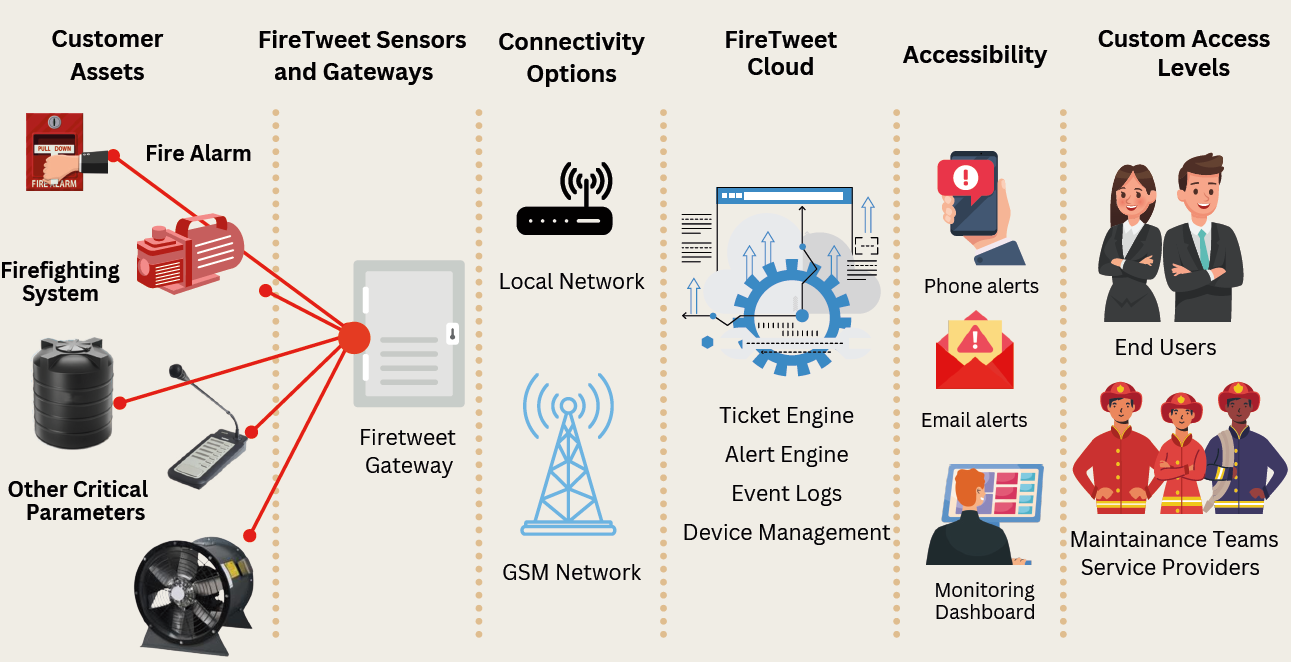
In today’s fast-paced era, development is increasing, and so are the risks. Therefore, however, this does not mean that development should be stopped. Our responsibility is to reduce risk. Passive and active fire fighting systems are installed in the building to reduce fire risk. But whether the said FIRE FIRE FIGHTING SYSTEM is good condition (ON or OFF), the occupier or those who maintain the FIRE FIRE FIGHTING SYSTEM do not always know. Also, if there is a sudden fire, there is delay in informing the fire brigade and increased the response time, resulting in huge loss of life and property at the fire site. Therefore, to avoid this, the building occupier, fire fighting maintenance person and the fire brigade must know the update about the fire fighting system of the building. Hence It is very important to use the advance technology.
These days, smart technology is so omnipresent that we often don’t think of it as anything more than “technology.” It’s everywhere in our home security systems, cars, thermostats, refrigerators, watches, televisions, and more. So why not include the Internet of Things (IoT) in fire protection?
IoT makes fire protection easier, more comprehensive, and more effective than ever. It integrates fire safety into building management, automates responses, and streamlines response protocols, potentially saving lives.
IoT stands for the Internet of Things. It refers to the interconnected network of physical objects embedded with sensors, software, and network connectivity. This allows everyday devices to collect, exchange, and act on data over the internet without requiring human-to-human or human-to-computer interaction.
An IoT (Internet of Things) fire fighting system integrates sensors, controllers, and cloud computing to enable real-time fire detection, remote alerts, and automated suppression. It dramatically reduces emergency response times and minimizes damage by pinpointing the exact location of a hazard and automating safety responses.
What Is IoT and What Does It Have To Do With Fire Protection?
The Internet of Things (IoT) refers to a network of physical objects that have internet connectivity and can communicate with one another in the cloud. You might have heard this concept referred to as “smart devices,” “smart homes,” or simply, “connected devices.”
But what does this have to do with fire protection?
It’s simple smart fire protection systems (also known as connected fire protection technology) are an active system that uses sensors to monitor environmental conditions automatically, and alert people in real-time. This can potentially improve response times and enhance the overall safety of the building.
How IoT in Fire Protection Systems Works?
IoT technology enhances the overall capability of fire protection systems, making them more responsive, integrated, and proactive.
Let’s break down three ways IoT enhances fire protection systems.
Real-Time Monitoring and Alerts
Internet connectivity enables IoT fire protection systems to monitor building conditions continuously in real-time. With advanced sensors, fire detection with IoT can pinpoint changes in temperature, smoke levels, air quality, and even carbon monoxide and analyze it for potential hazards.
If it detects an issue like a potential fire it can respond instantly by alerting stakeholders, building owners, maintenance, residents, and even EMS. As a result, people can evacuate to safety, and qualified personnel can intervene efficiently, significantly reducing response times and preventing fires from spreading and causing significant damage.
Predictive Maintenance and Analytics
IoT in fire protection systems doesn’t just mean quicker responses in the event of a fire. These systems can also perform predictive maintenance to fire protection equipment, proactively detecting issues before consequences arise—potentially before you even perform your regular system inspections.
For example, let’s say a particular smoke detector shows signs of decreased sensitivity. A smart fire protection system could alert maintenance personnel to inspect and replace it before it fails. As a result, you can rest assured that your system is always functioning optimally instead of worrying about equipment failing at the worst moment.
Key Components of an IoT Fire System
A standard smart fire safety system consists of several integrated layers:
Sensors: These serve as the "eyes and ears" of the system. Common sensors include smoke detectors, flame (IR/UV) detectors, heat sensors, and gas/LPG leak detectors.
Microcontrollers: Devices process the data collected by the sensors and decide when to trigger an alarm or suppression.
IoT Gateways & Connectivity: These transmit the sensor data to the cloud using Wi-Fi, 4G/5G, or low-power wide-area networks.
Cloud Platform: The brain of the system, which logs continuous environmental data, identifies trends, and triggers automated responses.
Actuators: The physical mechanisms activated by the system, such as automated water sprinklers, ventilation shut-off valves, and fire doors.
How the System Works in Real-Time
1. Early Detection and Verification
Continuous monitoring of temperature, smoke density, and flame presence allows the system to detect fires long before they spread. Advanced smart detectors can differentiate between actual fire hazards and false alarms (like cooking smoke) to reduce unnecessary disruptions.
2. Instant Alerts and Dispatch
If a fire is confirmed, the IoT gateway immediately communicates with the cloud. The system can:
Send automated SMS text alerts or push notifications to building managers and occupants.
Automatically generate a call to the nearest local fire department.
Use a GPS module to transmit the exact geographical location and building layout to first responders.
3. Automated Suppression and Evacuation
Instead of waiting for manual intervention, IoT systems can trigger immediate, targeted responses:
Turn on targeted water sprinklers or release suppressant gases only in the affected rooms.
Automatically shut off electricity and gas lines to prevent the fire from escalating.
Unlock security doors and guide occupants to safe escape routes via smart lighting and digital displays.
Benefits of an IoT Fire System
Faster Response: Real-time data transmission significantly cuts the time between ignition and the arrival of emergency services.
Pinpoint Accuracy: Firefighters receive exact coordinates and real-time data on how a fire is spreading within a building.
Predictive Maintenance: Traditional fire systems require manual testing. IoT platforms continuously monitor the health of every device (e.g., battery levels, sensor dust, water pressure), alerting technicians before a failure occurs.
Integration with Building Management Systems
If you use building management systems, IoT-enabled fire protection systems can integrate seamlessly, allowing for automated responses to fire events, further improving the speed of response and the overall safety of your building environment.
For example, if a fire is detected in an office building, fire detection with IoT could:
Activate fire suppression systems like sprinklers in the affected areas
Shut down HVAC systems to prevent smoke from spreading
Enable emergency lighting and alarms
Unlock emergency exits
Send elevator cars to the ground floor and disable them
This rapid, coordinated response could save crucial minutes in an emergency and potentially even save lives.
Practical Benefits of Using IoT in Fire Protection Systems
Using IoT in fire protection can bring significant benefits.
Here are three of the most important:
Improved Safety: Many IoT systems can detect fire hazards more quickly and accurately than traditional systems. That means that responses can be coordinated faster. This can be the difference between a small, contained fire and a catastrophic event.
Reduced Operational Costs: Launching IoT in fire protection systems may require an initial investment, but it can result in significant savings over time. For example, predictive maintenance supports a healthier overall system and prevents costly equipment failures. And the improved accuracy can limit false alarms, saving unnecessary emergency response costs.
Enhanced Data Analytics: Because it can continuously monitor and analyze the building environment for fire hazards, IoT in fire suppression systems generates a lot of data. In addition to detecting hazards in the moment, this data can be analyzed for risk assessment and long-term safety planning. For example, you might use data to identify certain areas of the building that are more prone to fire, allowing for targeted improvements.
In short, using IoT in fire protection allows you to be proactive about safety, while also reducing costs. It’s a win-win.
1. Automated Continuous Monitoring System (ACMS) based on Internet of Things (IoT) for the fire fighting system in a building or part provided for both Active and Passive Measures, ensuring that the fire prevention and life safety measures are in good repair and efficient working condition.
2. The provision of the ACMS can be done in two phases. The installation of ACMS shall be such that it will give necessary indication to both the owner or occupier as well as the system installer in the first phase. In the second phase, the critical alarms shall also be sent to the local fire and emergency services.
3. The ACMS shall be provided as under
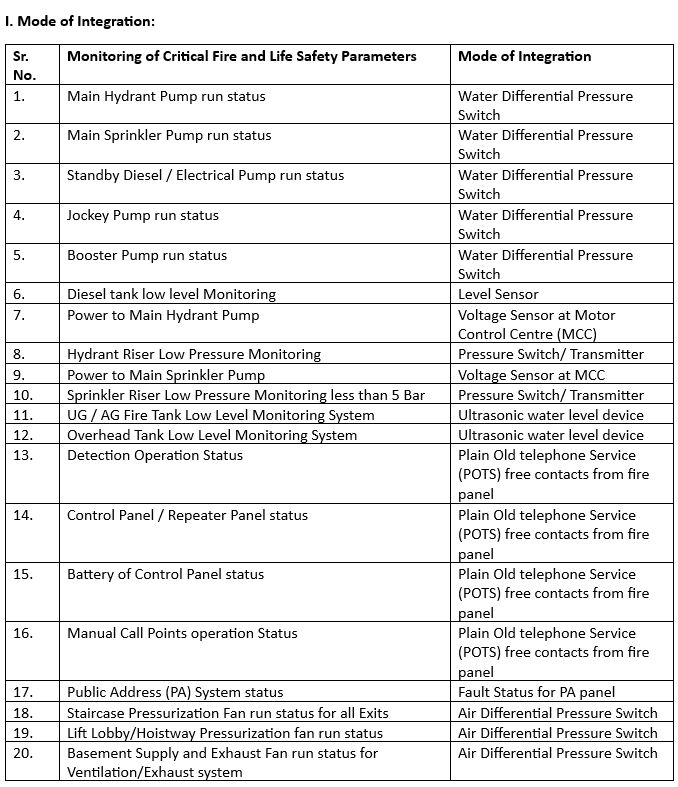
(a) System Status: The system shall be integrated with requisite mechanism enabling to know the status of each system which shall be generated and collected on any suitable IoT Gateway. The data collected then shall be then uploaded on any suitable Cloud server which will then send requisite real time information of the system health to owner / occupier and the system installer on email, short message service (sms) or on mobile through any suitable app service. Status of following systems shall be notified.
(b) Hydrant :
(i) Main Hydrant Pump run status.
(ii) Standby Diesel/Electrical Pump run status.
(iii) Diesel tank level Monitoring.
(iv) Power to Main Hydrant Pump (On / Off).
(v) Hydrant riser low pressure monitoring.
(vi) Jockey Pump run status.
(vii) Power to Jockey Pump (On/ Off).
(viii) Booster pump Pump run status.
(ix) Power to Main Booster Pump (On/ Off).
(c) Fire Water Tank :
(i) Underground / Aboveground Fire Tank Level Monitoring.
(ii) Overhead Tank Low Level Monitoring.
(d) Sprinkler :
(i) Main sprinkler Pump run status.
(ii) Power to main sprinkler pump.
(iii) Sprinkler riser low pressure monitoring.
(e) Detection System :
(i) Detection operation status (On/ Off ).
(ii) Control Panel / Repeater Panel status (working / non-working)
(iii) Battery of Control Panel status.
(f) Manual Call Points : Manual Call Points operation Status (On/ Off).
(g) Public Address System : Public Address System status (working / non working).
(h) Air Pressurization :
(i) Staircase Pressurization Fan run status for all exits Lift Lobby/ Hoistways.
(ii) Pressurization Fan run status for all Lift Lobby/ Hoistway.
(i) Supply and Exhaust Fan.- Basement supply and Exhaust Fan Run Status for Ventilation or Exhaust system.
Note: Following Data parameters will be monitored and will be send from local Gateway to Cloud Portal for Real time monitoring and Report Generation.
Procedural Requirements : The main objective of the IOT base system is to ensure that fire prevention and life safety systems provided in buildings are maintained in good repair and efficient working condition for,
(a) Digital Monitoring the Operations of the Fire Fighting Installation and Equipment;
(b) Digital Maintenance and Record Keeping of Fire Fighting Installation and Equipment.
These can be achieved by adopting following procedure guidelines,
(i) Providing minimum Digital Inputs and Analog Inputs depending upon the system requirement.
(ii) Machine to Machine communication by following MQTTS Protocol which will send the Data. MQTTS Protocol to send the Data to cloud portal on real time basis.
(iii) Connectivity to Cloud Using 4G/5G and above or Ethernet or WiFi or any other reliable wired or wireless medium which will receive data from IoT gateway at every 1 min interval.
(iv) Cloud will also send an alarm via SMS if no data is received from the IoT gateway for more than 15 mins. Cloud portal should generate alarm in case data is not received for more than specified time so we can ensure reliability on IoT system.
(v) Gateway should have UPS power and shall have a backup of up to 7 hrs in case of power failure.
(vi) Gateway shall have an in-built capacity to store a minimum 10000 event logs.
(vii) It should have real time clock to save data along with time stamp.
(viii) Reports like data report and alarm report should be available from cloud portal.
(ix) SMS and email alerts option should be available real time basis.
(x) Events should be stored in the Open-Source Database. Uptime should be at least 99%.
(xi) There should be provision to make API (Application Programming Interface) in future to send this data to local fire and emergency services. For local fire and emergency services, Alerts should be sent only for critical alarms e.g. Power Failure to Pumps, Sprinkler and Hydrant Line Pressure Low, Fault & Fire Conditions of the Fire Alarm System, etc.
Conclusion: It is concluded that ACMS system through IOT based system is very useful as fire and life safety point of view. Due to IOT system in Fire Fighting system we can get current information of building fire fighting system and also Fire tenders can reach on the fire site in minimum response time and hence we can save property and valuable life. Undoubtedly we save the property of Nation.
“ PREVENTION IS BETTER THAN CURE”
“USE NEW TECHNOLOGY AND SAVE YOURSELF AND YOUR PROPERTY”

Chief Fire Officer Nagpur

Vijay Dahiya, Fire Officer, Delhi Fire Services.

C. Lakshmi Prasad, Director of Fire Department (Retired), Telangana, Hyderabad, Chartered Engineer, Fellow of Institution of Fire Engineers (India), Member of Institution of Fire Engineers (UK), Ad DFE, NFSC, Nagpur (PhD).

Mr. Vijay Dahiya, Station Officer - Delhi Fire Services.