


TAK Mathews
Principal Consultant

Night of Diwali 2009, as everybody celebrated six families lost their family members. And a night when the fire fraternity lost six brave colleagues.
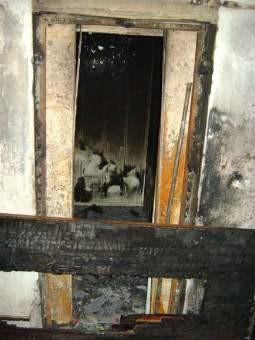
Figure 1: The lift in which 6 firemen lost their lives
Subsequently, your author's company was appointed by the Maharashtra Lift Inspectorate to investigate the tragic incident. In addition to possible causes, the investigations revealed a number of serious gaps.
The first gap was that the Indian standards for lifts prevailing at that point of time did not cover the requirements for fireman's lifts. While the National Building Code of 2005 had a section on fireman's lifts, the technical standards for lifts were silent on this. As a result, fireman's lifts even when provided, varied between suppliers in specification and operation. Due credit to the Bureau of Indian Standards and their working committee that within a short time this gap was corrected.
The second serious gap was that there was very little interaction and collaboration between the fire fraternity, the lift industry experts, consultants, developers, architects etc. Each constituent had a different understanding of what was required or could be practically provided. Within months, your author put together a workshop of fire officers from around the country, representatives from the NBC, lift industry, consultants, developers and architects.
The third but most serious gap was that the firemen at most levels had very little understanding of the functioning and limitations of fireman's lift. In fact, the standard short version name for Fireman's Lift, i.e. Fire Lifts gave the impression that these lifts were fireproof.
October this year will be the 15th anniversary of the tragic Tarangan incident. How has India approached Lifts and Fire in these 15 years? What has India learned?
On the positive side, the interaction between the firemen's fraternity and the elevator industry has improved significantly. Your author has personally spoken at over 3 dozen forums around the country on the subject. Many industry colleagues too have spoken on the subject. There is also active participation from the firemen's fraternity in standards and code formulation. The 2016 edition of the National Building Code has incorporated feedback and requirements from the chairman of Part 4 of the NBC as well as the director of Maharashtra fire services. The NBC 2016 has an elaborated section on firemen's lifts and has been expanded to also cover evacuation lifts.
However, there are still undesirable gaps.
Since the Tarangan incident of 2009, to the calendar, 17 people lost their lives in elevators during fire. Without exception, the people killed were either involved in fighting fires or assisting in evacuation. Without exception the fatalities occurred because the lifts were within unprotected lobbies and because the lifts opened on to the incident floor. These buildings were before the NBC 2016 and lifts were not in aprotected lobby.
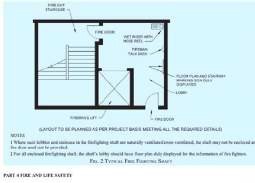
Figure 2: Lift in a protected lobby
Despite these events and theNBC 2016 requiring a firefighting tower with a protected lobby, this requirement is still widely ignored. Efficiency and aesthetics find higher priority. Irrespective of what may be specified or what may be demanded, the only reliable and safe lift for use in a fire or emergency situation is a lift enclosed in a protected lobby.
Though there are much better and closer interactions between the fire fraternity and the lift industry, the interactions have not found much enthusiasm from the other actors in the building design and construction. Even with the availability of clear directions laid out by NBC 2016, there are jurisdictions that have decided to re-invent the wheel. Some of these misguided directions are on account of interactions with self-appointed lift experts who provide suggestions and recommendations. These recommendations, some that sound very convincing, not only violate the prevailing standards and codes but could lead to serious consequences.
For instance, the code defines the fireman's lift as lift provided in a building for the purpose of aiding firefighters in evacuating trapped persons in the building and to take the equipment for fighting fire to upper levels with minimum delay. Worldwide it is very clear that a proper fireman's lift is for assisting firemen in firefighting and evacuation.
On the other hand, lifts that maybe available for evacuation as part of a building's self-evacuation strategy during the golden period before the emergency rescue teams reach the lift are referred to as evacuation lifts. This is particularly important for occupants with mobility constraints.
Yet, some jurisdictions have mandated a requirement of separate fire evacuation lift(s) for the firemen which is not a norm anywhere else in the world.
What is further confounding is that it is expected that these fire evacuation lifts are to be located at mid landings. While it contradicts the NBC Part 4 requirement that lifts should not open into a stairwell, it adds multiple problems. First an evacuation lift is primarily for somebody with mobility restrictions - if located at the mid landing how will that person climb up or down the flight of staircases? This mid landing requirement also contradicts the guidelines recommended by the HARMONISED GUIDELINES & STANDARDS FOR UNIVERSAL ACCESSIBILITY IN India 2021 issued by the Government of India. Further occupants waiting for the lift will create hurdles for others using the staircase and even firemen climbing up.
Another gap pertains to vision panels for automatic door lifts. The Indian standard for lifts prohibits vision panels for automatic door lifts. While vision panels are redundant for automatic door lifts, the primary reason for this prohibition is because a glass embedded in the sheet metal door panel may compromise the fire resistance of the lift landing door. Yet some jurisdictions ignore the Indian Standard provision and insist on vision panels for lift doors. In fact, it is understood many government bodies ignore the provisions of the Indian standards and insist on vision panels for their large requirement of lifts. A clear case for argumentum a fortiori - if part of the standard can be violated, the rest too can be ignored.
The argument put forth by some firemen for the vision panel is that they can see the external conditions before opening the door. This demonstrates a lack of understanding of the process that has to be followed while using a lift for firefighting or evacuation. The processes and precautions are detailed very well by firefighting veteran David McGrail in his book "Firefighting Operations in High-Rise and Standpipe-Equipped Buildings" and must be a compulsory study material for all.
An issue that demonstrates inadequate understanding is when the requirements prescribed include fire resistance for car doors along with the landing doors and sometimes even the overall car itself. Mandating that car doors and car must be fire resistant while being superfluous, is technically and practically impossible. Those suppliers who claim to conform to these requirements are being dishonest. Meeting the fire resistance requirement for the car doors and car would virtually render both inoperative.
In conclusion, safety can't be achieved without honest and non-adversarial collaboration between all the constituents involved in make a building possible. Without that we will add to the Tarangan statistics.

Principal Consultant


Maharashtra has written the world’s most practical fire-monitoring rule. The question now is whether building owners will read it properly.

Installing a fire system is easy. Keeping it alive is the real engineering. Because a fire never sends a warning — and when it comes, your system gets one chance to work. At Northern Star Engineering, that chance is now in your pocket.
