


Harshvardhan Singh works as an Assistant Manager (Equipment Service) at a global mining utility vehicle manufacturer. He is positioned at Zawar Mines, Udaipur, India.

Harshvardhan Singh
Assistant Manager
Introduction
In mining, development is the preparatory, capital-intensive phase of constructing infrastructure, sinking shafts and accessing the ore body. Production is the subsequent, long-term operational phase focusing on active extraction, processing, and selling the minerals. Explosives are very much critical to underground mining, as they offer precise and effective rock disintegration for development and production. However, the confined environment, restricted ventilation, narrow escape routes and close proximity of workers significantly maximize the risks associated with explosives. Hazards such as misfires and premature detonation can have severe repercussions if not managed properly. Therefore, strict adherence to safety procedures and international standards is critical.
Types of Explosives Used in Underground Mining
The main types of explosives used in underground mining include ANFO, emulsion explosives and slurry explosives.
ANFO is a is an industrial explosive typically composed of 94% porous ammonium nitrate and 6% fuel oil by weight. Slurry explosives are gelatinous aqueous solutions that consists of an oxidizer such as ammonium nitrate and a fuel containing sanitizers like aluminium. Emulsion explosive were developed in early 1960s to improve performance of slurry explosives. It is made by trapping tiny droplets of liquid fertilizer (usually ammonium nitrate) inside a coating of oil or wax, using a special stabilizer to keep them perfectly mixed.
Selection Criteria and Suitability
Choosing the right explosive is critical for both safety and performance in underground conditions. For instance, ANFO, a cost effective and powerful explosive but suitable for dry conditions only. Emulsion explosives are good for wet ground or where water seeps through the rocks. Slurry explosives are also impervious and reliable. Permitted explosives are used mainly for coal mines, specifically engineered to produce a cooler flame so they don't ignite pockets of methane or coal dust. Hence choosing the right explosive is a critical safety step.
Handling and operational safety
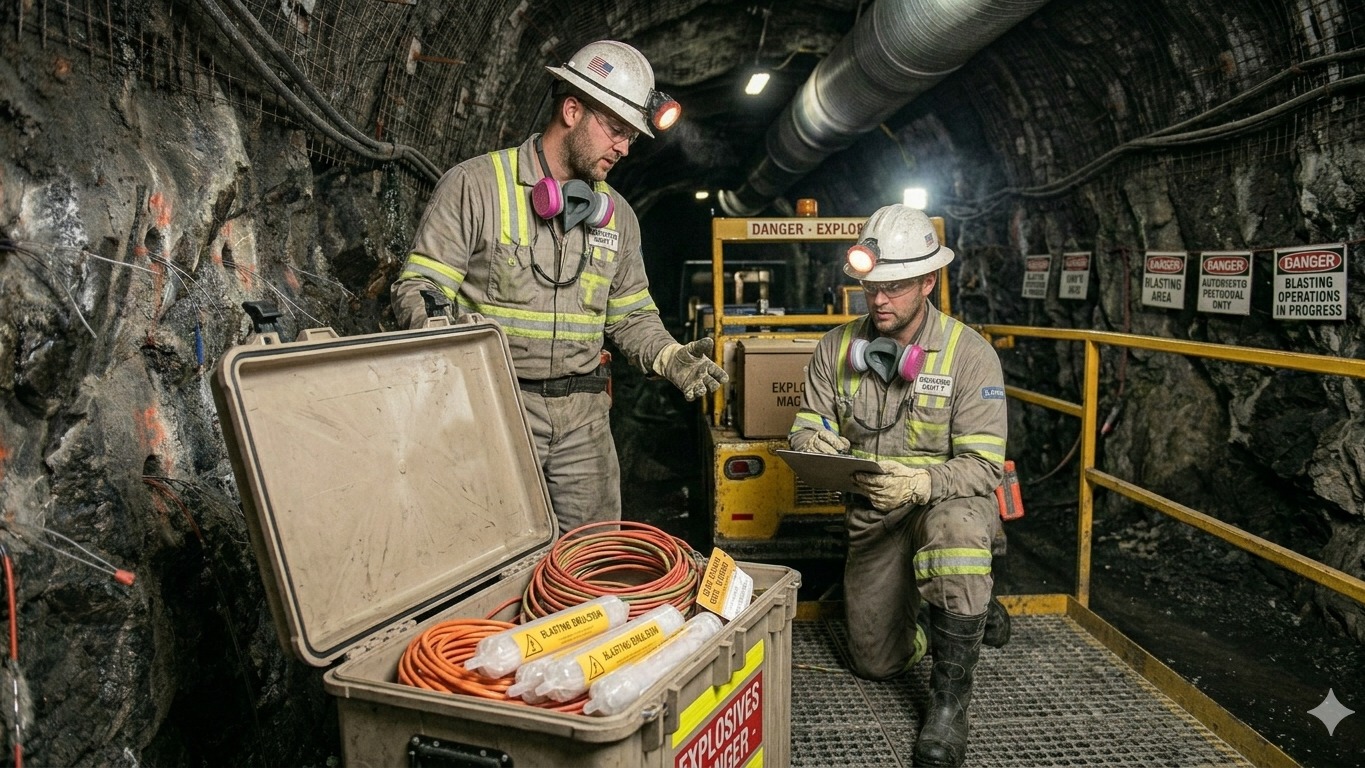
Proper storage of explosives in underground requires special consideration. Explosives and detonators must be stored in approved surface or underground magazines that are dry, adequately ventilated, dehumidified, temperature controlled and immune to any kind of mechanical damage. Segregation between detonators and explosives is mandatory. The International Council on Mining and Metals recommends implementing risk-based storage systems and strict access control to prevent unauthorized handling and ensure traceability. Security measures such as installing surveillance systems, using access control mechanisms such as keycards or biometric locks and conducting background checks for all personnel with access to explosives can prove to be very helpful in preventing unauthorized access to explosives.
Transportation of explosives in underground mines presents unique challenges due to narrow drifts, gradients and interaction with mobile equipment such as LHDs and mine trucks. Only special vehicles or approved explosive carriers should be used. Explosives and people should never be transported in the same vehicle. As per the Institute of Makers of Explosives, transport routes must be planned, traffic controlled, and handling should be kept smooth to avoid shock, friction, or accidental initiation.
Charging and blasting operations in underground demand high levels of competency. Drill holes must be properly cleaned and charging should be done using approved techniques to avoid air gaps or overcharging. Stemming, which is packing material on top of the explosive, is important to control blast energy and reduce flying rock. Before blasting, all personnel must be withdrawn to a safe location and warning systems must be activated. The Occupational Safety and Health Administration emphasizes strict blast clearance procedures and controlled access to blasting zones.
Post-blast hazards are more critical in underground environments due to confined spaces. Toxic gases such as NOx and CO must be ventilated before re-entry. Here post-blast water sprinkling helps in several key ways - dissolves toxic fumes including NOx and CO, exposes butt ends of blast holes, cools the hot rock and reduces the risk of methane ignition. Proper ventilation and gas monitoring are essential to ensure safe working conditions. Misfires pose a serious threat and must be handled only by authorized and experienced personnel following a defined waiting period and standard procedures.
DOs and DON’Ts (Explosive Handling)
✅ DOs
Store explosives in approved, dry, and ventilated magazines.
Use dedicated and authorized transport systems underground.
Ensure all personnel are trained and certified in blasting operations.
Follow proper charging, stemming, and initiation procedures.
Ventilate and test air quality before re-entry after blasting.
Treat all misfires with extreme caution and follow procedures.
❌ DON’Ts
Do not carry explosives in man-riding vehicles.
Do not mix detonators with bulk explosives during storage or transport.
Do not blast without proper clearance and warning signals.
Do not re-enter blast areas without gas clearance confirmation.
Do not attempt to handle misfires without authorization.
Do not ignore ventilation or gas monitoring requirements.


Maharashtra has written the world’s most practical fire-monitoring rule. The question now is whether building owners will read it properly.

Installing a fire system is easy. Keeping it alive is the real engineering. Because a fire never sends a warning — and when it comes, your system gets one chance to work. At Northern Star Engineering, that chance is now in your pocket.

Assistant Manager