


Dr. Arindam Bhadra
Director

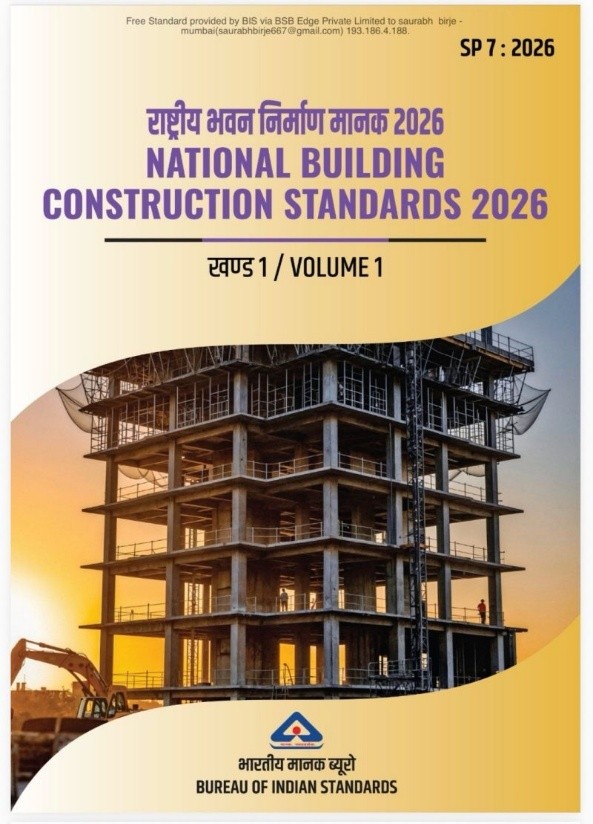
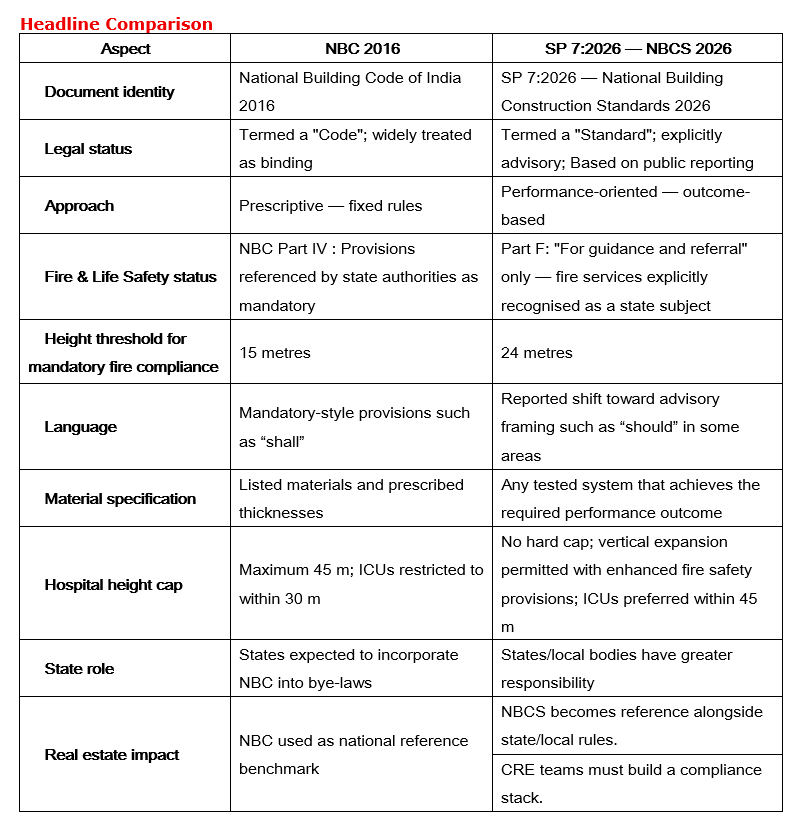
On Thursday (30-04-2026) the Bureau of Indian Standards (BIS), National Building Construction Standards (NBCS) 2026 replaces the National Building Code (NBC) 2016, transitioning from a prescriptive code to a voluntary guideline framework. Key changes include making fire safety provisions advisory rather than mandatory ("should" vs "shall"), raising mandatory fire compliance thresholds to 24 meters, and enabling vertical expansion of hospitals. This is not an amendment. It is a full replacement by the Bureau of Indian Standards. Part 4 Fire & Life safety (NBC 2016) is now changed in Part F — Fire and Life Safety. The new standards came into effect on April 30, 2026, simultaneously replacing the widely adopted National Building Code of India 2016 (SP 7: 2016).
The Three Headline Changes
From "Code" to "Standard." NBC 2016 was technically voluntary but widely treated as binding. NBCS 2026 is explicitly a guidance and reference framework. Implementation responsibility now sits with state governments and municipal authorities.
From prescriptive to performance-oriented. Designers no longer follow fixed wall build-ups or fixed insulation thicknesses. They pick any tested system that delivers the required outcome — the fire resistance rating (FRR), the U-value, the acoustic rating.
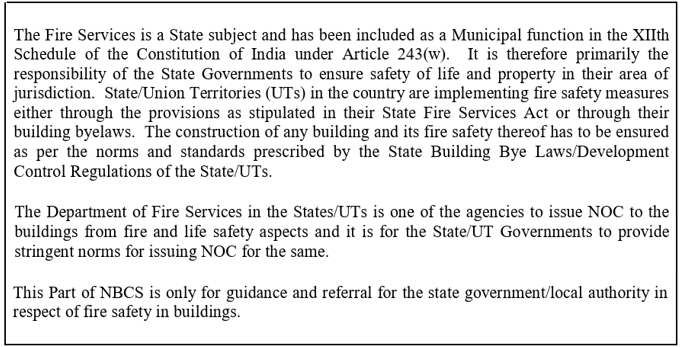
Fire and life safety is now advisory. Under the Indian Constitution, fire services are a state subject. NBCS 2026 formally recognises this. The central document is a guidance framework; states and cities adopt, adapt, or replace it.
The fire safety threshold has also shifted: mandatory central provisions now begin at 24 metres of building height, up from 15 metres under NBC 2016. A large segment of India's mid-rise stock has moved out of automatic central regulation.
Based on updated safety standards (IS 3614 revisions and NBC 2026 guidelines), uninsulated (UD) fire doors are being phased out in India, making a minimum 30-minute insulation (PI or ID) mandatory for all exit fire doors to prevent heat transfer. These doors must be tested for integrity and insulation, featuring smoke seals, intumescent seals, and self-closing mechanisms to ensure safe evacuation.
Why the Change Was Made ?
Legal and regulatory clarity. Although NBC 2016 was technically voluntary, the use of the word "Code" caused widespread confusion. Courts repeatedly treated it as binding, generating disputes, project delays, and litigation. The Cabinet Secretariat's Deregulation Cell recommended replacing the code with a "Standard" framework to remove this ambiguity.
Performance-oriented innovation. The 2016 NBC's prescriptive style was out of step with modern construction technology. Slim-wall cold storage, prefabricated hospitals, aerogel-insulated retrofits, modular AI data centres, and high-strength dry-partition systems often had no clean compliance path under prescriptive rules.
Federal alignment. Fire services and building bye-laws are constitutionally state and municipal subjects. NBCS 2026 formalises a federal model — central technical guidance, state-level implementation. The BIS Fire Safety Committee chair has publicly clarified that NBCS provides "a guiding framework" and that ensuring structural and occupant safety is "the responsibility of states and municipalities."
To address this issue, the Deregulation Cell under the Cabinet Secretariat recommended replacing the code with a standard-based framework. The intent was to reduce ambiguity and create a system that acts as a guiding reference rather than a mandatory rulebook.
Public reporting has stated that the government replaced the existing National Building Code with a new standard and retained fire safety provisions as advisory. Public reporting has also stated that the new standard gives states and municipal bodies greater rights over development control norms, fire safety and administration.
While NBCS 2026 introduces modern concepts like smart fire systems and integrated design approaches, it simultaneously weakens critical elements that have historically protected lives:
Passive fire protection (compartmentation, shaft closure)
Fire stopping systems (still not mandated)
Enforcement mechanisms (Fire NOC, third-party audits)
Evacuation engineering (completely missing)
The reality is simple: In India, where compliance itself is inconsistent, reducing prescriptive clarity can lead to unsafe interpretations.
One of the most concerning gaps is the lack of focus on shaft integrity and fire stopping areas that are responsible for rapid vertical fire spread in buildings.
At the same time, the code does not mandate:
Fire NOC before occupancy
Independent safety audits
Smoke management validation
These are not optional elements. They are life-saving systems.
Code, Standard and Enforceability: A Practical CRE Framework
The shift from “Code” to “Standards” should not be read simplistically. In practice, corporate real estate teams should evaluate compliance through a layered framework covering eight dimensions:
• National reference standards NBCS 2026 and relevant BIS standards.
• State legislation fire services Acts, municipal Acts, town planning laws, development control regulations and building rules.
• Local authority requirements building plan approval, fire NOC, occupancy certificate, environmental and infrastructure permissions.
• Special authority requirements SEZ, industrial parks, airports, metro influence zones, defence zones, IT parks or township authorities where applicable.
• Project-specific risk standards occupancy type, occupant load, basement use, data centres, kitchens, laboratories, battery storage, high-density workplaces and mixed-use conditions.
• Corporate standards internal engineering, EHS, accessibility, resilience, business continuity and ESG requirements.
• Insurer and lender requirements fire protection, electrical safety, sprinkler systems, impairment management, testing, maintenance and loss prevention requirements.
• International good practice NFPA, FM and other applicable global standards where local rules do not fully address the risk.
Greater Responsibility for States and Local Authorities
The shift toward Greater Responsibility for States and Local Authorities under NBCS 2026 marks a move from a centralized, prescriptive "Code" to a decentralized, "performance-oriented" framework.
This transition formally acknowledges that fire services and building regulations are constitutionally state subjects and municipal functions.
Key Areas of Local Responsibility:
Legislative Control: Since the NBCS 2026 is strictly a "Standard" (advisory) rather than a "Code," its provisions—including critical fire and life safety norms—only become legally binding if and when state governments and local bodies explicitly incorporate them into their own building bylaws.
Enforcement Thresholds: Local authorities now have the responsibility to set their own safety thresholds. For example, while the central standard has raised the fire safety threshold from 15 metres to 24 metres, states must now decide whether to close this "safety gap" for mid-rise buildings through local rules.
Administrative Discretion: States and municipalities are expected to define their own detailed norms regarding building height, spatial requirements, and administrative procedures. This allows cities to better adapt to local socio-economic conditions and land availability.
Technical Scrutiny: Under the new performance-based approach, local officials must evaluate whether a building's unique design and materials meet specific safety outcomes (e.g., a "2-hour fire resistance rating") rather than simply checking a fixed list of materials.
Implications for Governance:
Increased Liability: By moving away from central "handholding," the onus for ensuring structural and occupant safety rests entirely on local governance systems.
Innovation vs. Enforcement: While this decentralization allows for faster construction and architectural innovation, it places a higher demand on the technical capacity of municipal authorities to review complex "engineered safety analyses".
Regulatory Fragmentation: This shift may lead to a "patchwork" of different safety standards across India as different states adopt or adapt the NBCS 2026 framework at varying speeds.
This is very Sad!! Power is now given to state govt for fire safely norms implementation. We will now see dance of corruption in the name of CFO NOCs with gaps in fire safety across India. Uniform fire code of India should have been in place as a minimum compliance document. I suspect strongly that Non-Negotiable aspect would now be negotiated widely.
What Changes for Passive Fire Protection
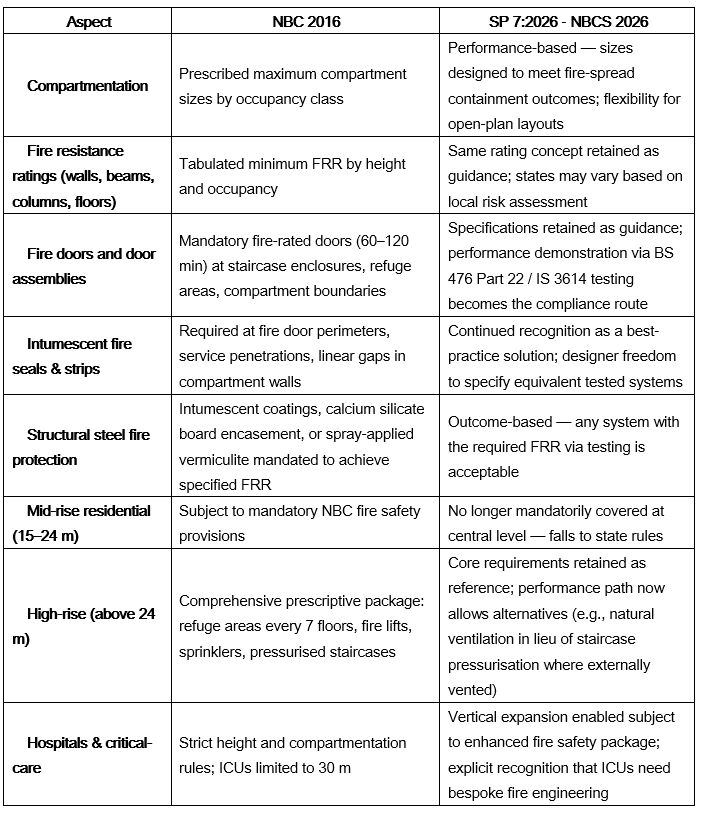
Under NBC 2016, a fire engineer designing a high-rise project would consult Part 4 (Fire & Life Safety) and find tabulated fire resistance ratings, prescribed compartment sizes, mandatory refuge area frequency, and specified door, wall, and floor build-ups. Compliance meant reproducing those requirements on the drawings.
Under NBCS 2026, the same engineer is given outcome targets — for example, a 2-hour FRR for a separating wall — and must demonstrate compliance through:
BIS-listed system test reports (IS 3614, IS 12458, IS 9594)
International equivalents (BS 476 Part 22, EN 1364, ASTM E119, UL 263)
Engineered fire safety analysis backed by recognised software (PyroSim, FDS, Pathfinder)
Approval by the relevant state fire authority based on the submitted documentation.

Element-by-Element Changes
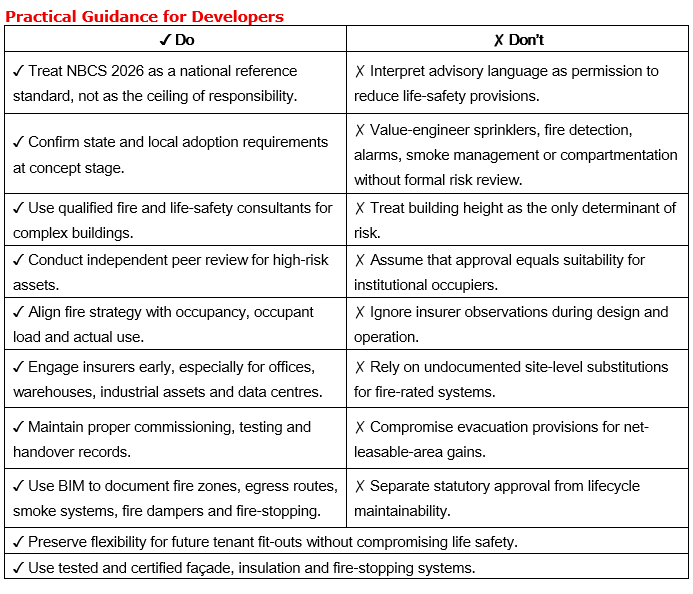
Risks Developers Must Manage
Compliance uncertainty
If states adopt NBCS differently, developers operating across multiple states may face inconsistent interpretations, creating project risk and approval unpredictability.
Approval versus acceptance gap
A building may receive statutory approval but still fail the expectations of multinational occupiers, insurers, institutional investors, REITs or lenders. Approval is necessary but not sufficient.
Fire and life safety interpretation risk
Where provisions are interpreted as advisory, project teams may be tempted to value-engineer critical systems such as sprinklers, fire detection, alarm systems, smoke management, stair pressurisation, refuge areas, compartmentation, emergency lighting or fire-rated doors. This can create long-term liability.
Insurance and lender scrutiny
Insurers and lenders evaluate actual risk, not only legal approval. Fire protection, electrical safety, asset maintenance, system testing and emergency preparedness remain central to underwriting and risk assessment.
Litigation and reputational exposure
After an incident, the question is rarely limited to “Was there approval?” The questions are often: Was the building reasonably safe? Were recognised standards followed? Were systems maintained? Were risks known? Were occupants protected?
Greater Responsibility for States and Local Authorities
NBCS places stronger emphasis on decentralised governance of construction norms
State governments and urban local bodies are now expected to:
Frame detailed building regulations
Define height and spatial requirements
Establish enforcement and compliance mechanisms
The Bureau of Indian Standards (BIS) provides the framework, but implementation lies with local authorities
S. K. Dheri, heading the fire safety committee at BIS, clarified that the standards act as a guiding framework, while ensuring structural and occupant safety is the responsibility of states and municipalities.
In essence, while NBCS provides greater flexibility, it also demands higher accountability and technical preparedness at the state and city level to maintain safety standards.
Implications for Corporate Real Estate (CRE) and Occupiers
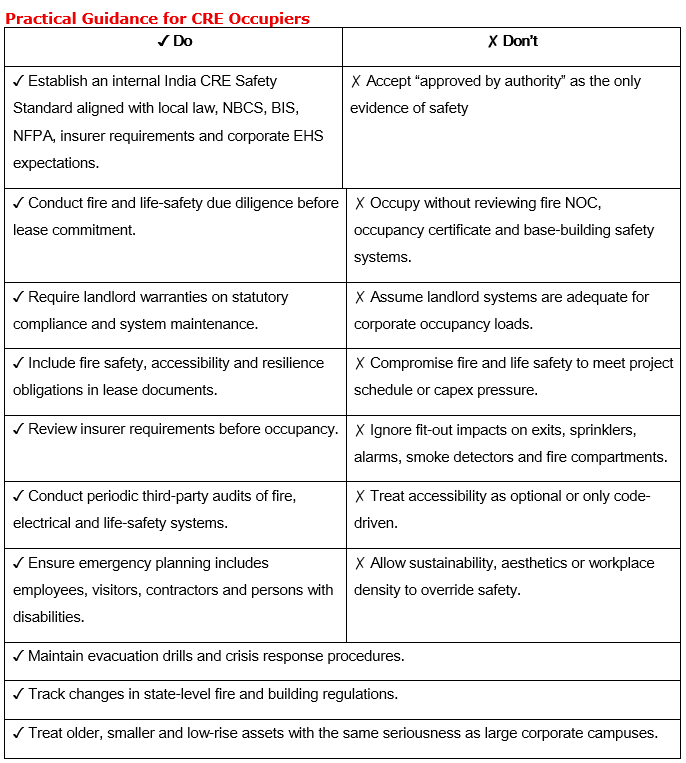
For corporate real estate teams, the transition from NBC 2016 to NBCS 2026 should be treated as a governance trigger. Large occupiers should not reduce their internal requirements because national guidance becomes more advisory — in many cases, they will need to strengthen internal standards to ensure consistency across portfolios.
CRE duty of care remains unchanged
Corporate occupiers have obligations to employees, visitors, vendors, customers and communities arising from building laws, employment law, EHS expectations, insurance requirements, ESG commitments, business continuity needs and brand reputation.
Minimum compliance is not enough for institutional-grade assets
Global occupiers, banks, technology companies and healthcare organisations typically operate with internal standards that exceed local minimum requirements. This should continue.
Lease due diligence becomes more important
Before leasing or occupying a building, CRE teams should verify the following:
• Fire NOC and occupancy certificate status
• Sprinkler coverage and fire water capacity
• Fire detection and alarm system design
• Staircase width, travel distance and exit capacity
• Refuge area design where applicable
• Smoke extraction and pressurisation systems
• Electrical safety and transformer/HT room protection
• Basement fire protection and ventilation
• Façade fire performance
• Emergency power and life-safety backup systems
• Accessibility compliance
• Maintenance records and statutory inspection history
• Insurance engineering observations
• Landlord emergency response capability
Portfolio governance must become state-specific
CRE teams operating across India should track state-level changes in fire rules, building bye-laws and adoption of NBCS 2026. A single national compliance assumption may no longer be sufficient.
Implications for Insurers, Lenders and Investors Insurers may require stronger evidence
Insurers are likely to request fire protection system design basis; sprinkler and hydrant coverage; fire pump and water tank capacity; electrical safety audits; thermography reports; fire door and compartmentation records; emergency lighting and exit signage testing; fire alarm cause-and-effect testing; maintenance and inspection records; hot work controls; impairment management procedures; and evacuation drill records.
Premiums may reflect actual risk quality
Buildings that demonstrate strong fire protection, maintenance discipline and risk governance may be more attractive to insurers. Assets relying only on minimum statutory compliance may face more scrutiny.
Institutional capital will prefer safer assets
REITs, global investors, lenders and multinational tenants are likely to prefer buildings with clear compliance, strong safety systems, ESG credibility and transparent documentation.
Asset resilience becomes part of value
Fire safety, electrical safety, structural robustness and business continuity are not just compliance issues. They influence asset value, leasing demand, operating cost, downtime risk and reputational resilience.
What NBC 2026 Improved Over 2016 ?
• Stair pressurization: natural ventilation alternatives now recognized as permitted alternatives where feasible
• Atrium smoke management: Annex F retained and further elaborated with detailed makeup air and exhaust provisions
• Facade glass requirements: fire protection and smoke exhaust aspects more detailed
• Addressable fire detection systems referenced with alignment to IS/ISO standards
• Performance-based design approach introduced as alternative compliance pathway
• Fire Command Centre (FCC) provisions strengthened for integrated smoke system control
• Progressive evacuation strategies introduced for hospitals
What is Removed / Reduced ?
NBCS Part F has consciously eliminated outdated andambiguous provisions:
a. Over-Prescriptive Requirements
Earlier rigid rules replaced with performance alternatives
b. Redundant Clauses
Several overlapping clauses simplified or removed
c. Generic Design Assumptions
“One-size-fits-all” approach reduced Encourages project-specific risk assessment
d. Outdated Technologies
Reduced reliance on obsolete systems Encouragement for modern suppression and detection technologies
The following clauses are made in conflict with the NEC, and CEA (MSES) Regulations, 2023
Mistakes start from the scope and definition sections and till the end. While the scope covers the buildings alone, the definitions and recommendations cover the power plants and transmission substations. As a result, the Ministry of Consumer Affairs should be apprised of the dangerous and mischievous recommendations which are against the prevailing safety Regulations and Standards. Bus bar trunking is made mandatory in the Regulations in respect of MSBs where tragedies happen due to toxic smoke of cables. This important provision is neglected in this code.
To cite a few definitions based on the textbooks and practices of a few consultants, and manufacturers are reproduced are furnished below:
1. Cl.2.1.80- earthing resistance, Cl.2.1.180-Voltage classification, Cl 2.1.176 Touch Voltage (conveys conventional touch voltage also as against the definition of IS/IEC 61936-1). The sentence :”Touch voltage measurements can be ‘open circuit’ (without the equivalent body resistance included in the measurement circuit) or ‘closed circuit’ (with the equivalent body resistance included in the measurement circuit) voltage by which an installation or part of an installation is designated.” is totally misguiding.
2. Cl. 2.1.36.5 and Cl.2.1.36.5.2 are confusing ones
3. Cl. 2.1.68 Earth – incorrect
4. Cl. 2.1.176 see 1
5. Cl. 4.2 Substation and Switchrooms
4.2.1 Location and Other Requirements
6. Cl. 5.3.5.2 Transformers of rating upto 2500 kVA are permissible as per BIS. Hence recommendations to restrict the use upto 1600/2000 kVA is not required. Also such ratings are unavoidable in the current scenario of meeting higher loads like HVAC plants etc. in Data Centres and Malls.
1. Cl. 5.3.6.4 Insisting coordination for loads exceeding 10kW alone is incorrect. Every circuit requires protection.
2. Cl.5.3.6.6 Use of active filters is incorrect in certain cases. Such specific type of mitigation is incorrect.
3. Cl.5.3.7.1 Using 4 core cable for sizes above 16 sq.mm alone and sizing of neutral is incorrect as per desig details furnished in the NEC.
The fault protection measures, namely, fault loop impedance is omitted intentionally, why I am stressing the word 'intentionally' is due to the introduction of earth electrode resistance values which is not relevant for the LV AC and DC installation. The world has changed the concept since 1968. ( Pl see Cl. ). But we have not moved to the next step. The paradigm shift should evolve atleast now itself. Pl see Annexure. )
The entire standards should therefore be aligned with the current Regulation and Code in this subject. ( R and Cl of NEC). The document hence requires a complete revision. Otherwise, a conflict will persist between Codes and Regulations which will confuse the professional.
Earth resistance is not a stand alone value in the design to afford shock protection. Value of current through human body is determined by the voltage and duration in any standards. This is achieved by an automatic disconnection of fault protection devices like breakers. To achieve this, the fault loop impedance is to be restricted to a value of milliOhms depending upon the characteristics and rating of such devices. This is achieved by the protective earthing conductor in a TNS earthing system. But the impedance of such path will be in the order of few tens of Ohms if we consider earth electrodes concept. Hence the current division through such earth electrodes will be less than thousandth part of the current sensed by the tripping device. The purpose of earth electrodes in the LV installation is to make a referencing and to avoid EMC issues using single point earth electrodes. Depending upon the soil resistivity at the final earth electrode provided for the neutral of the source transformer or generator, in spite of 100s of earth electrodes in the earthing design. Seasonal variation also can affect the value in a non- consistent manner. Unfortunately, this earth electrodes are given importance, due to the wrong or intentional approach to help the chemical earth electrode manufacturers who exploited the situation for several decades.
Equipotentialisation is another factor which is also carefully rejected, where a challenge arise in a supply side overvoltage.
The concept of equipotentiality and earth loop impedance are carefully avoided by the in the document for the reasons best known to the proposer. That is a sensitive area like hospital locations, inflammable areas and generating plants, either an unearthed system or an intentionally introduced resistance/impedance is mandatory.
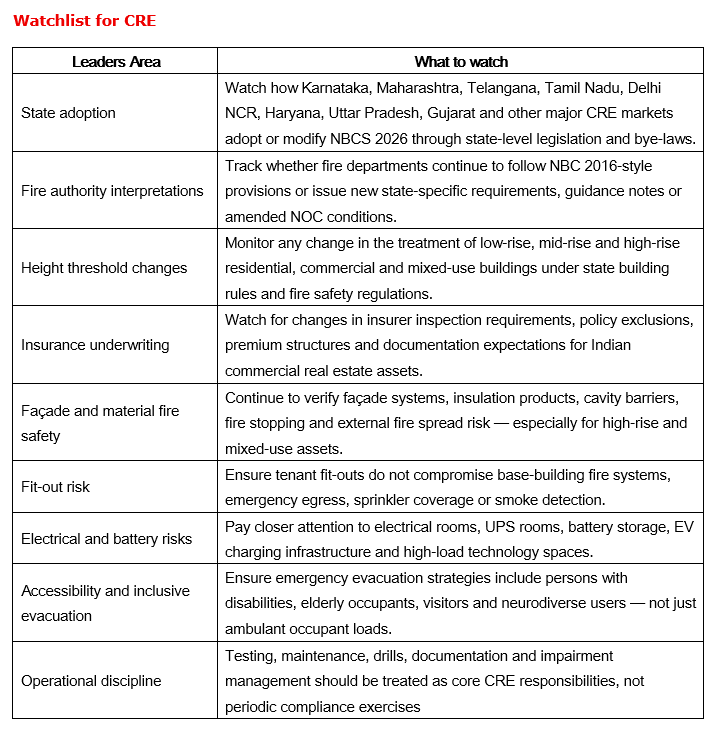
Recommended CRE Governance Framework
Corporate real estate teams should adopt a three-layer governance model that distinguishes the legal floor from the professional standard and from the corporate responsibility ceiling.
Fire and Life Safety: Advisory, Not Mandatory
One of the most critical and debated aspects of NBCS is the treatment of fire and life safety provisions. Initially, the Deregulation Cell had suggested excluding this section altogether. However, due to strong objections from fire safety experts, it was ultimately retained.
That said, the nature of these provisions has undergone a fundamental shift. Under NBC, fire safety clauses used the term “shall,” indicating mandatory compliance. In NBCS, this has been replaced with “should,” significantly reducing enforceability and making these provisions advisory.
The NBCS document explicitly states that “fire and life safety” is meant only for “guidance and referral for state govt and local authority in respect of fire safety in buildings considering that ‘fire services is a state subject and a municipal function’ as per the Constitution.” This marks a clear shift of responsibility from a centralized guideline to decentralized implementation.
Conclusion
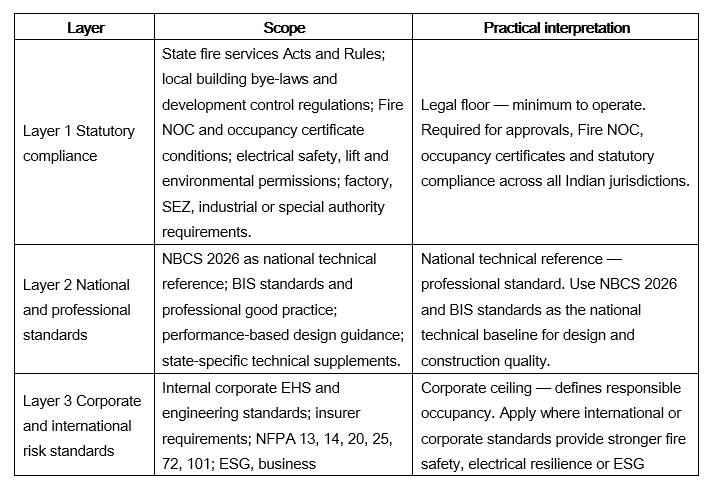
The transition from NBC 2016 to NBCS 2026 is an important moment for Indian real estate. It can support faster approvals, reduce procedural ambiguity and encourage innovation. However, the change also places greater responsibility on states, developers, consultants, occupiers, insurers and CRE leaders to interpret and implement building safety with maturity.
• For developers — NBCS 2026 may provide flexibility, but not permission to lower the safety bar.
• For regulators — it requires clearer state-level adoption and consistent enforcement.
• For insurers — it will increase the importance of verified, documented risk controls.
• For corporate occupiers — it reinforces the need for strong internal safety governance.
• For CRE leaders — compliance and responsibility are not always the same thing.
In this situation INDIA need strongly two no’s code by experienced professional.
1. National Fire Code of India
2. National Life safety Code of India
While several states are still in the drafting phase, Maharashtra, Karnataka, and Delhi are currently leading the way in integrating the advisory NBCS 2026 guidelines into mandatory local regulations as of early May 2026. Whereas Uttar Pradesh, Gujarat under Drafting stage. No Such plan for Chhattisgarh, Uttarakhand, Himachal Pradesh, Punjab, Goa, Rajasthan, Chandigarh, Jharkhand, Bihar, Orrisa, West Bengal, Sikkim, Assam, Manipur, Meghalaya, Tripura, Mizoram, Nagaland, Arunachal Pradesh etc.
Reference:
BIS - Bureau of Indian Standards https://standards.bis.gov.in/website/standard-details?encryptedId=eyJpdiI6IllkL3E3d3pBK20zSDUwbytObzNnS1E9PSIsInZhbHVlIjoiOG9VUExlOHlvV1VqRHRTMUFHb2hCdz09IiwibWFjIjoiZDVhMDdkODdjNDYzZTZkZjYxZjNhOWE1ZTgwOGI4ZWE3NjdiNTM2NGI2ZjI5ZDFlYTViMWJhNzlmYmRhNzY2MSIsInRhZyI6IiJ9&standardNumber=SP%207:2026

Director

Article Contributed by: Sateja Naik, Manager, Firetech Equipment & Systems Pvt. Ltd.

Maharashtra has written the world’s most practical fire-monitoring rule. The question now is whether building owners will read it properly.

Installing a fire system is easy. Keeping it alive is the real engineering. Because a fire never sends a warning — and when it comes, your system gets one chance to work. At Northern Star Engineering, that chance is now in your pocket.
