


Vishal Maheshwari
Director & Head

Protect what is behind that rack using the rack
With the expansion of artificial intelligence, internet connectivity and easy accessibility, data has sparked an unprecedented demand across industries. This need has compelled organizations to embrace the new digital online formats to stay afloat the competition.
The pandemic-induced lockdown acted as another catalyst for this shift to modern data processing. The pandemic compelled industries to expand their online presence, from remote work and education to e-commerce, retail, and beyond.
A report by CRISIL pointed out that India’s data consumption alone has unveiled a sharp 38% surge year-on-year for FY2021 on account of the pandemic. To sustain this data storage and processing, the demand for internet bandwidth has increased. As per the Synergy Research Group, the data center market was expected to witness a CAGR of 12% between 2019 and 2024.
Thus, in India, the data center market is witnessing a huge expansion due to a massive boost in virtualization and cloud-based technologies.
Inadequate Security at Data Centers
Data has also become a more sensitive target for theft. Information is now a currency of its own carrying the wealth of businesses, personal identities, and sensitive details. Data centers are hubs that house computing and networking devices that store, process, analyze, and distribute large volumes of data. Moreover, the sheer volume of information stored in data centers has multiplied, making them into digital treasure troves.
Whether they are on-premises data center provisions or third-party partnerships, known as co-location, organizations face issues concerning the security of the stored data. These are mainly of two distinct categories – Software security and physical security.
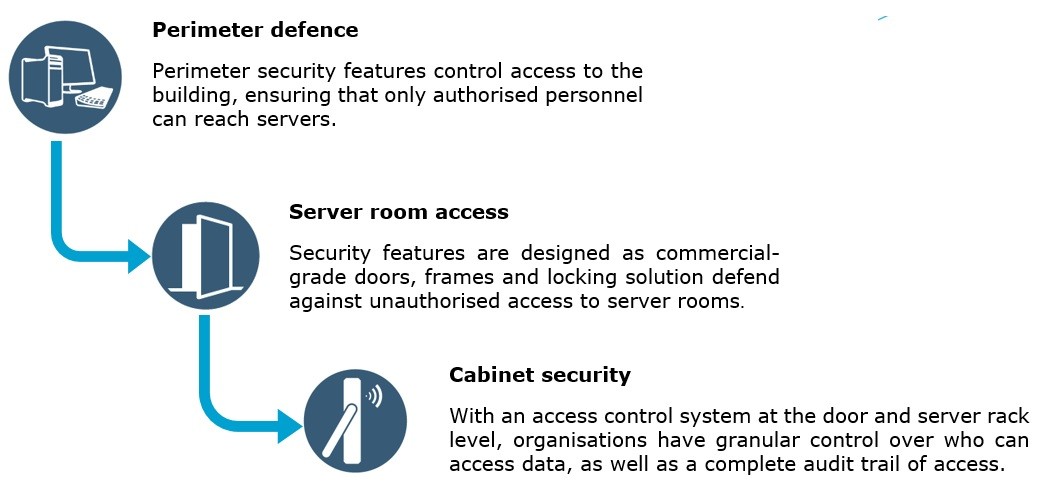
While software security involved protection against technological breaches like malware prevention and firewall management, the physical aspect focused on asset security like employee, hardware, access authentication, and data center equipment protection. These measures are very effective on the outer layers of the center. The same does not hold true for the innermost layers. For example, a malicious employee with authorized access to outer layers can easily breach and tamper with a server. This can render the entire outer security layer irrelevant.
Intruders gaining physical entry pose a significant threat. Whether it's through unauthorized personnel or individuals exploiting access credentials, unauthorized access can lead to data breaches or system manipulation. Employees or individuals with legitimate access can pose risks. Whether intentional or accidental, insider threats involve misusing privileges, accessing data they shouldn't, or tampering with hardware. Data centers are valuable targets for theft or vandalism. Theft of equipment, servers, or even data itself can occur if physical security measures are lacking. Accidents, mishandling, or intentional sabotage can damage servers or other critical hardware components, impacting data center functionality.
Over the years, data centers have used mechanical locks to secure individual racks, to safeguard such sensitive data, and prevent intruder attacks. However, mechanical locks alone are not sufficient anymore. Tampering using basic tools, duplication of mechanical keys, and other break-in methods are some common practices used for server data theft.
This is where the need for additional security at the rack cabinets level arises. Developments in technology demand the highest level of security sophistication. While many spaces need security, the regulated environment of data centers requires a particularly specialized means of access control.
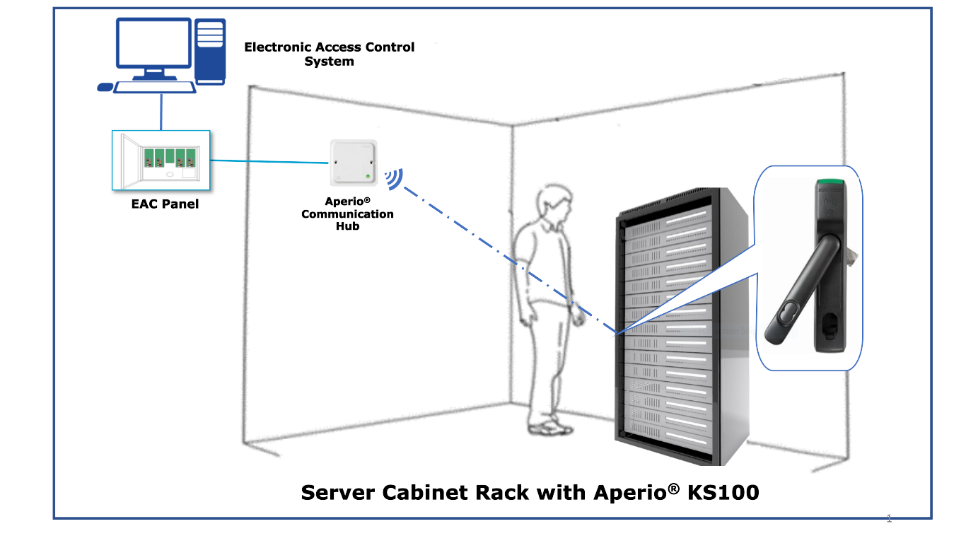
Secure your Server Rack with Aperio® Wireless Locking Technology
Entry-level staff does not necessarily understand the criticality of data protection. Also, security systems such as PIN pads & card readers are now being installed on server enclosures, but these come with their own set of limitations. One of them is the limited functionality of locking and sensing door position. Installation of such systems is possible only at new premises as they cannot be retrofitted to existing data centers or enclosures. This not only spikes up installation costs but also requires additional investment in reworking the infrastructure.
Aperio KS200 wireless server rack lock is the perfect solution to these problems which can be accessed seamlessly through Aperio wireless locking solution.
Aperio, a solution under the ASSA ABLOY group, is a technology developed to address modern threats with hassle-free installation. This new wireless advanced solution complements new and existing electronic access control systems. It upgrades the controllability and security level at all premises. All changes can be implemented in real-time using the access control software and communication hubs without visiting every cabinet with a portable updater.
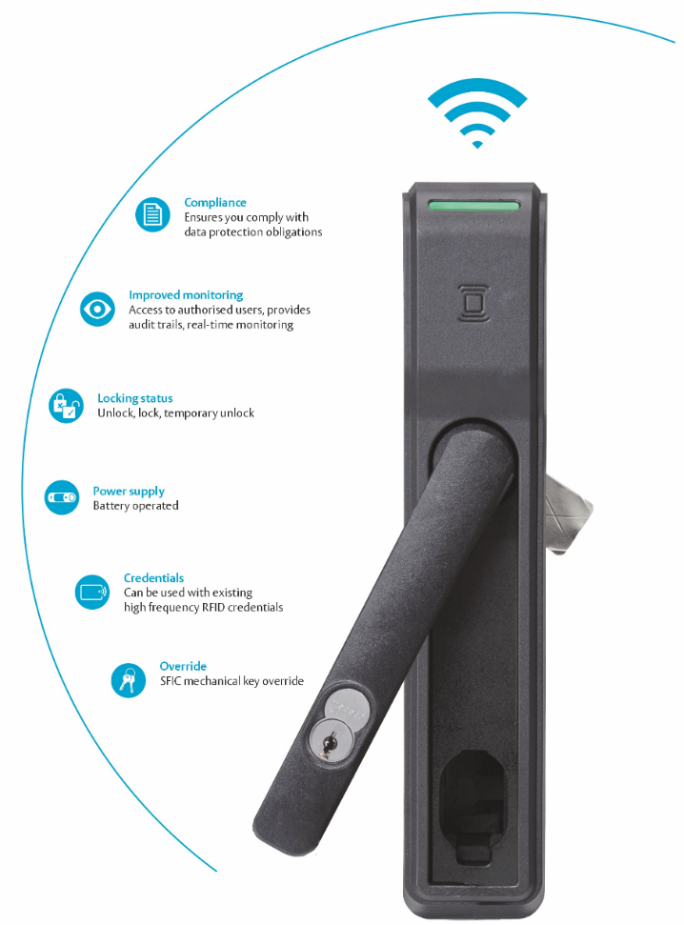
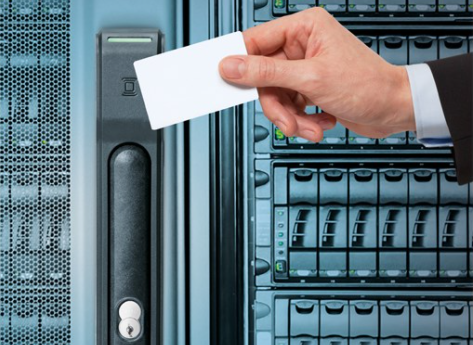
The Aperio devices can be installed in all type of doors; glass, wooden, metal and even server racks. Once installed, Aperio locks integrate with your existing Electronic Control Access System and communicate wirelessly through an Aperio Communication Hub. With online integration, you can present any of your smart credentials to the lock. The access decisions are then communicated and recorded by the system wirelessly. The ROI of this deployment is future-proof as Aperio supports industry-leading RFID technologies and in the case of KS200, it includes varied monitoring options such as door and lock status, handle status monitoring and tamper monitoring.
Aperio Server Rack Lock empowers you to control physical access to your servers enabling businesses to meet data protection and privacy compliance. With all communication happening wirelessly, the security manager has complete, state-of-the-art control over access points.

“We are witnessing a new era of integrated security solutions facilitated by ‘intelligent’ devices connected to internet with low cost of installation. Retrofitting and upgrading existing mechanical locks to an internet-based wireless access management system not only offers greater control over the system but also makes them more interoperable and interconnected.” says Vishal Maheshwari, Director & Head, Digital Access Solutions and Electromechanical division, ASSA ABLOY Opening Solutions (MEIIA).
Components like locks have also become Intelligent and are offering dynamic access control capabilities without any are infrastructural change.
“A future where doors are smarter, connectivity is wireless, and locking is genuinely intelligent – that is our vision for Aperio and for those who will be using it.”
For more information please contact: ASSA ABLOY Opening Solutions
Article Contributed by: Sateja Naik, Manager, Firetech Equipment & Systems Pvt. Ltd.

Maharashtra has written the world’s most practical fire-monitoring rule. The question now is whether building owners will read it properly.

Installing a fire system is easy. Keeping it alive is the real engineering. Because a fire never sends a warning — and when it comes, your system gets one chance to work. At Northern Star Engineering, that chance is now in your pocket.

Director & Head